

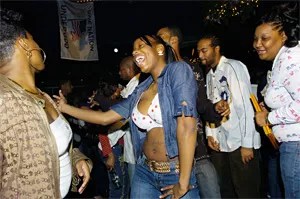
A sparkling Buick creeps down the gridlocked street. Its front doors are flung open, unleashing the heavy bass of Young Jeezy. Other cars cruise by in the same cocky manner — doors open, passengers hanging out, bass thumping — as four hip-hop chart-toppers clash in one ear-piercing symphony.
It’s 3:05 on a Sunday morning. This is the West Bank of the Flats.
“This does not seem like normal behavior,” says John DeLuca, who’s watching the procession on his laptop. This is just one of several scenes DeLuca captured with his handheld video camera last summer. The others feature more chaos: a man hurling a brick through a car window; gunshots sending guys leaping into cars and speeding off; fleeing cars colliding, leaving a lonely cop, surrounded by rowdy, drunken bystanders, looking overwhelmed and panicky.
“I can’t find ‘The Belt Beater’; where is that?” DeLuca asks himself, searching for a video of a guy taking off his belt and beating the roof of a nearby car. “That was a classic.”
DeLuca, a thin man with fingers gnarled by manual labor, owns a small Flats storage company. From the roof of his business, he made these films with the simple goal of Sasquatch photographers everywhere: to document unbelievable images. But DeLuca has become the Flats’ very own Zapruder. The grainy videos are now central to the crusade of Cleveland Councilman Joe Cimperman, who, at the behest of Flats business owners, is trying to shut down Mirage on the Water, the hip-hop club he blames for the twice-weekly carnival of lawlessness.
Cimperman, the burly but baby-faced politician who represents the Flats, is convinced that the mayhem captured by DeLuca’s lens is attracted, even encouraged, by Mirage’s promotions. Mostly he points to “Jeans and Moet Night,” where the dress code is abandoned and cheap champagne is peddled. The club’s refusal to put security outside the club only makes things worse, Cimperman says.
“The way they perceive they’re going to make money — teenager-like machismo — naturally breeds chaos,” he says. “It’s not the clientele that’s to blame. It’s the management.”
The neighborhood’s business owners, not saddled with political aspirations, put it less delicately.
“They have a clientele with a disregard for safety or human life,” Cindy Kriz, a manager at the Flats’ Stonebridge luxury condos, says of the Mirage. Young urbanites pay up to $1 million for the posh condos, but they’re forced to flee the streets after 1 a.m., she says. “On the weekends, we have robberies, shooting, murders. It’s a very scary environment.”
Bar owners tell similarly grim tales. The gridlock from cruising cars gets so bad, they say, customers can’t drive out and are too fearful to leave the bar. “I gotta get them out at 2:30,” says Marc Garofoli, owner of McCarthy’s Ale House. “Eventually, I just push them out, and they huddle near the door.”
Garofoli keeps his employees inside until 4 a.m. or later, when the Mirage crowd dissipates. Jim Salopeck, who owns the nearby Metropolis, says he can’t find enough employees willing to brave the streets after their shifts. “The people that come out of this club, they’re not there to do good things,” says Kriz. “They’re all hip-hopped and excited.”
The bedlam isn’t limited to the streets either. Last month, a man pulled a pistol out of a Timberland boot and emptied it in the club. A woman, sitting idly on a couch inside, claimed to have been pierced in the leg by a stray bullet.
So when Cimperman finally went after the club’s liquor license this fall, he became the yuppie messiah for Flats business owners. They’ve repaid him by collecting evidence and packing hearing rooms, ready to rail about their unwanted neighbor.
“When you have a rotting piece of fruit attracting flies,” says one Flats landlord, “you get rid of the fruit.”
The owner’s office at Mirage is a spacious, tidy refuge above the vibrant dance floor. The walls — perpetually shaking with heavy bass — are decorated with yellowing newspaper stories that laud the club and its “color-blind” demographic. This is Dean Salivaris’ war room. It’s where the elderly Greek entrepreneur — who dresses like a yachtsman and smells of delicate cologne — meets with high-priced attorneys, nurses a wounded ego, and considers his enemies.
“It’s jealousy,” he says. “They’ve been after me for years.”
Salivaris has many enemies to consider. A dues-paying member of the Flats OxBow Association, a business-and-resident alliance, he feels betrayed by his neighbors. But he reserves his greatest spite for Cimperman. Why, Salivaris wonders, is it his charge to keep the streets around his club free of crime? The Flats has never been a place for peaceful strolls. And like the rest of Cleveland, the district is underpoliced. In the neighborhood’s heyday, there were 30 to 40 cops herding its rowdy crowds, according to police union chief Steve Loomis. “Now, when the Mirage is open, you’d be hard-pressed to find a police car,” says Loomis, who never misses a chance to advocate for more police jobs.
“Every time something happens in the projects, they blame me,” Salivaris says, referring to Lakeview Terrace, a public-housing development a few blocks west. “Don’t my taxes pay for police?”
Cimperman scoffs at the idea that the city’s to blame for violence outside the club. But it’s Salivaris’ other argument — the same one being levied by a troubled hip-hop club across the river — that’s most dangerous for Cimperman and his ambitions.
Like Mirage, West Sixth’s Spy Bar draws a mostly black crowd to a mostly white playground. After a July 4th shooting in a parking lot near Spy, the councilman launched a loud public campaign to close the club. Cries of racism rang out instantly.
“The fucker lies and harasses,” says Raj Singh, who owns Spy. “I get blamed for every black crime in the Warehouse District.”
Salivaris now lays the same claim. He calls the crusade against the Mirage “ethnic cleansing.”
“Do they want me to throw these people in the river or send them back to East 55th Street?” he asks.
These are the accusations that Cimperman, who recently announced that he’s running for congress, can hardly afford. So they’re the ones he most vehemently denies. “They always cling to the argument that this is about racial disparity,” he seethes. “The only color that matters is green, and that’s the color of Salivaris’ greed.”
The debate will continue to rage in hearings before the state liquor board, which should decide in about a month whether Mirage can keep its liquor license. Actually shutting the club down could take years.
Flats stakeholders are already exhaling. When they heard about the Mirage shooting, they sent celebratory text messages to each other, and copies of the police report were faxed from business to business. Soon, they hope, DeLuca will be able to retire his video camera for good.
“My God,” says Cimperman. “He has a shooting in his club at the same time we’re having hearings to revoke his license. It doesn’t look good.”
This article appears in Dec 12-18, 2007.
In order to take a look at this situation logically, let’s look at some facts. Most violence that proceeds from the downtown area nightclubs are predominately black. Is it wrong for “Urbanites,” to celebrate their livelyhood, listen to “Chart topping,” music that most young and old white people listen to, or dress up their cars with 20″ rims and so on. No it is not wrong! What is wrong is that everyone is pointing their finger in another direction besides their own. There are so few hip-hop clubs in the downtown area, so when one appears, people don’t know how to act. The Cleveland police should be involved. First, it is the cities job to ensure the safety of others. Second, the freedom of speech should not be taken away from the club-goers, and thirdly, everyone in this situation has made a choice which entales some good outcomes and some bad. Now it is their turn to take the responsilbility. For example, the girl who was allegedly shot at the Mirage. She made the choice to go to a club known for violence and chaos, and should not cry about it, just like the rest of the people.
Metropolis is no better. We’re berying a friend Saturday because of the patrons at that place. The Cleveland Plice are just as much to blame. They’re to pussy to patrol the areas that need it. They’d rather patrol places like Garage Bar (I once counted 7 cops there at once just hanging out). For some reason I don’t think that’s the real problem. They just want to carry their badges and guns and have the look of a cop but they don’t want to do much more than arrest drunk frat boys.
RIP Daymon Mumford
How many other “clubs” can be connected to shootings and violence? The “gridlock” is due to people that do not follow traffic laws. The “loud noise” is due to people that don’t follow noise ordinances. The shootings and violence are attributed to people who do not obey basic principals of respect. It is not the job of the “club” owner to police people who enter or leave his club – why should he care? They pay their money and get what they want. He only caters to their needs. The fact that it is a hip hop club or predominantly “black” club has nothing to do with the issues. Get people to follow laws and we don’t have this problem. The problem is with Cleveland – the problem is that Cleveland is a segregated city and has a race crisis. Don’t believe me? Answer these questions: Where do you live? What “color” is your skin? Why do you live where you live? The problem is with CLEVELAND
Check out Scene’s blog to see some of the video footage of the West Bank chaos — including a dude throwing a brick through a car window.
http://blogs.clevescene.com/cnotes/2007/12/lets_go_to_the_replay_booth_fl.php
The Flats ghetto bars may as well count there days as over. My friend, Daymon Mumford was killed by the quality crowd attracted by these fine establishments, Metropolis and Mirage. YOU messed with the wrong people this time…..Cleveland’s lack of patrol, and regards for the safety of its citizens will DEAL with this issue, we WILL NOT give up until CHANGE. These 2 bars will not be in business once we are done with them. They keep saying it was a “stray” bullet not “intended”. WTF!!! There shouldn’t have been ANY bullets despite their intended path, the path that took my beloved Mesh from us. WAKE UP CLEVELAND, its called BROKEN WINDOW SYNDROME. Look at all those pieces of shit walking our streets of the place you call home and CLEVELAND you ALLOW to do so with their deadly weapons of choice…..and b/c ignorance and pure hatred these pieces of shit took one of the BEST people this world can offer. And those pieces of shit continue to walk our streets! You better be on your knees begging for mercy b/c God will hunt you down and justice will be served.
POLICE PATROL!! PLAIN AND SIMPLE…. look at the videos in you other article, those are not people leaving a club, the cars they drive are backed in a driveway entrance on center street. If they were at a club they would have been parked in a parking spot in the lot or parallel to the street. Those are the loitering thugs every business down there wants gone. They know they can hang out and have a street party and not be bothered. PUT COPS DOWN THERE TO DRIVE THEM OUT. It should not be up to the police that work at Metropolis off duty to walk a block away to run these people off, but they do when they get within a distance of the place. PUT SECOND DISTRICT ON REGULAR PATROL DOWN THERE FOR GOD SAKES!!!!
I work for tenk machine on center and see this all the time
Kudos to the Scene for the well written article. The Flats violence has continued for years now with little reduction in crime, much of which has gone unreported. It’s prompted some of the businesses there to patrol the streets themselves via off duty police, private security and tv cameras. The answer isn’t a once every couple month sting or checkpoint, the hoods come back minutes after law enforcement leaves. There needs to be continued police patrols there and up on West 6th as well. I understand there is one patrol car in the flats at all times. That covers both hte east and west banks, the south side as well! It’s simply not enough for the number of patrons at the bars, clubs, businesses, restaurants. They didn’t even have extra patrols when the charity poker was there last summer! It’s also Ironic that EMS and the fire department can get to a scene faster than the police can. If there is a shooting or fireworks, everyone flees and the streets again become empty.
Another item that would help would be enactment and enforcement of a curfew for both those under 18 and under 21 to get the people on foot off the street after 2am when the crime rate jumps drasticly. I would also fault some of the clubs for staying open all night, however some of those staying open after 2:30 am have done so to alleviate the traffic congestion which occurs when all leave at once. After 2AM, all streets should be made exit only with only cabs and persons with business id’s allowed back in. Sorry but whoever decided to allow and build luxury appartments in an industrial and entertainment area should not have done so. There was no concern for other businesses or the traffic congestion. And little concern for it’s own residents safety with crime ridden subsidized housing blocks away.
Deapest sympathies to Mesh, family and friends. I didn’t know him personally but have seen the teams promotion at various bars. And to those that had the shootout a block away, do the right thing, turn yourself and your weapons in. The violence needs to end.
Witnesses? Many are afraid of retailiation for violating the unwritten snitching code and or report something they’ve seen somewhere else or at a different time.
we are just rehashing the same thoughts and feelings which came out concerning these people after the July 4th shootings on west 6th street. In the past year there has been a major increase in the numbers of black patrons to the warehouse district on Friday and Saturday nights. In the past, Thursdays and Sunday nights typically saw these crowds drawn to this “white” playground. However, they now come for the action when its most crowded. Unfortunately how they live and act are at odds with the way white people do. This is cultural at its base. This is the conflict. There has been a major increase in police presence in the warehouse district, mostly keeping them in check. There has been no parallel increase of police on the west bank. Sometimes police will try to direct traffic around Center or Main streets, but that is all. These young black crowds are a problem because most of them do not go to the actual clubs to spend money and support them. They go to cruise the scene, to hang out around
the scene. These people show no respect for others, no decency, no willingness to obey the law (they drive down the wrong side of the street, block streets, run lights, stop signs, walk in the middle of the road, impose their music on you, etc.. the list goes on. The problem is they have no home life, no parents to teach them right from wrong,
respect, common decency, how to act in public. They have no education, no background to learn these things. This is the unfortunate problem. They dont come from the civilized suburbs or college campuses where we learned how not to be untamed animals. This, my friends, is the truly SAD truth of the matter. It is mostly racial, but you do find some white idiots mixed in with them, unfortunate enough to share a similar upbringing. It is a behavior problem, learned vs. never learned.
Can the city enact an under 21 curfew? Didn’t they have anti cruising laws enacted after the problems on W25th by Moda, and the gang activity along most of Detroit avenue a couple years ago? What responsibility do clubs have over activities not on their doorsteps but blocks away?
You need to realize that Clevelands 5 largest nightclubs are on the west bank yet they get little protecetion and have to “Do it themselves” I don’t think any of the clubs do carry out beer sales yet, there’s plenty of liquor hip flasks and beer bottles littering the entire flats. Perhaps the state liquor control needs to get involved as well if they dare to set foot on River rd
Councilman Cimperman and the cuty should be ashamed! Everyone knows that where there is a bar, there is always trouble. If I had a video camera on 99% of the bars anywhere I would cature fights, vandalism, arguments etc.. The only reason The Mirage and Spy has recieved all the attention is because the proximity to residents and the city’s latest “vision” of the Flats. To the residents in the Flats, what did you expect when you moved into the entertainment part of the city? Peace and quiet? Have you forgotten about all the people who were breaking into the cars all over The Flats 10 years ago? Were all those incidents from Mirage customers? To the other businesses of the area, stop whining and get more police to patrol the whole area. Patrol, not harrass. You other owners sound jealous. If you think getting rid of the Mirage will increase your sales and create a safer West Bank, you are kidding yourselves. Your business will the the next to go so the city can build more condos or Jacobs can increase his empire. Wake up, open your eyes and see what is really happening.